Nathaniel Bassey's Hallelujah Challenge — What Really Happened That Month
BY GMUSICVIBES EDITORIAL
Published Jun 18, 2026
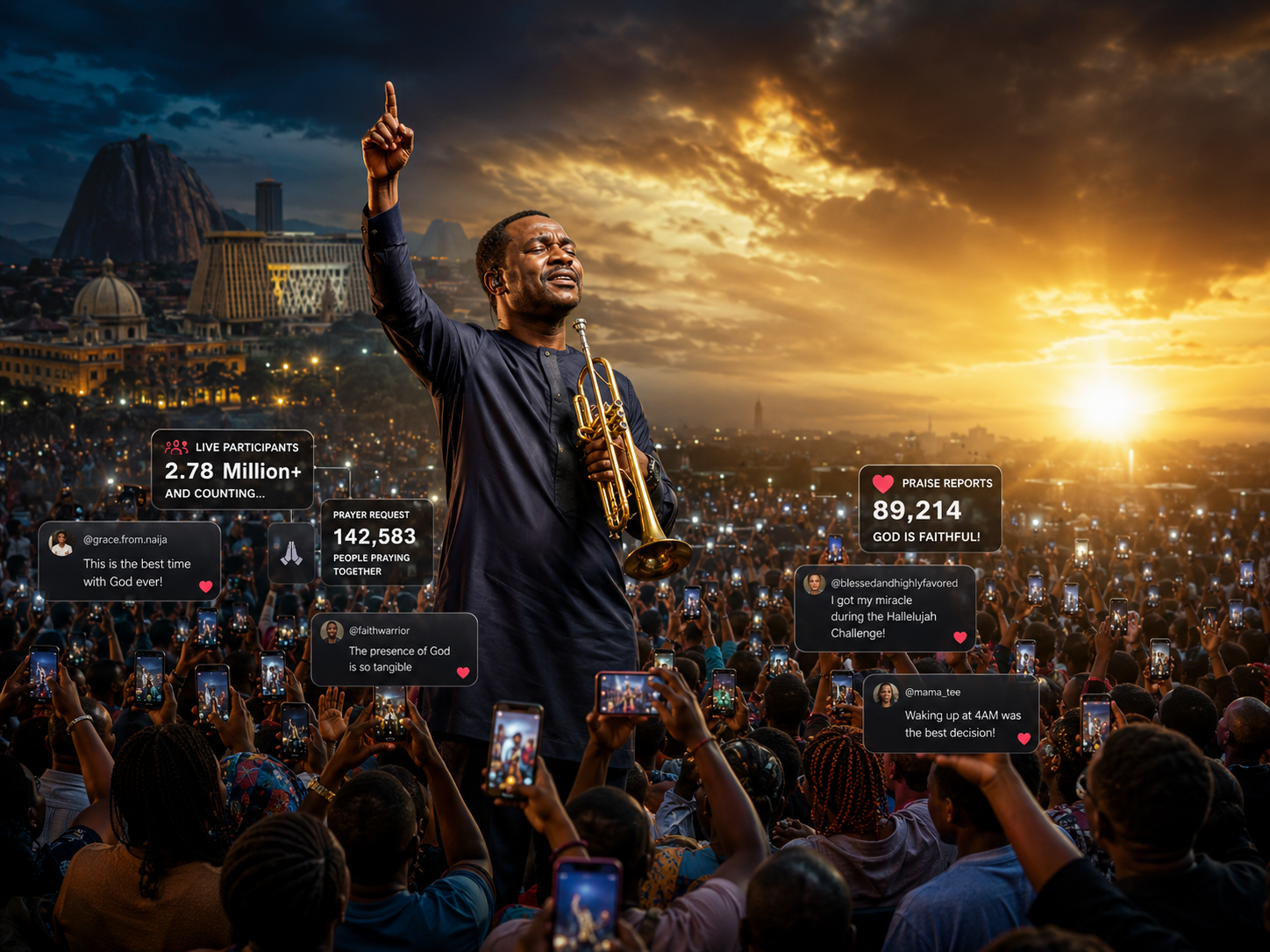
How a personal fast and a living room livestream turned into one
of the largest recurring prayer movements in the world.
Most viral moments have a clear
origin story you can point to — a marketing team, a launch date, a calculated
bet on timing. The Hallelujah Challenge has none of that. It started in a
living room, during a personal fast, with one man pressing the live button on
Instagram because he sensed he was supposed to.
Nearly a decade later, it has
become a recurring global event that draws hundreds of thousands of
participants at midnight, gets cloned by scammers trying to profit off its
size, and has been deliberately kept unmonetised by the very person who could
have made a fortune from it. That combination — massive scale and a stubborn
refusal to cash in — is rare enough in any industry. In gospel music, it's
almost unheard of.
Here's what actually happened,
and what's happened since.
A Fast, Not a Campaign
In May 2017, Nathaniel Bassey
was in a personal season of fasting. Whatever he was working through privately
during that month, he's described what came out of it in spiritual rather than
strategic terms: a sense that once the fast ended, God wanted him to lead
people in a specific kind of praise — not quiet devotion, but loud, midnight,
Acts-16 praise.
He referenced the story of Paul
and Silas directly — the two men who, while imprisoned and beaten, sang praises
to God at midnight, and the prison doors broke open. That passage, Acts
16:25-26, became the entire theological framework for what he was about to do.
Not a worship session. A jailbreak.
So he announced it. Join him in
worship every night, he said, at 12 AM. He tagged it the Hallelujah Challenge.
There was no campaign plan behind that hashtag. There was a man with a phone, a
living room, and a conviction that something was supposed to happen at midnight
for thirty days.
The Numbers Nobody Predicted
What happened next surprised
even Bassey himself.
By the second or third week,
nightly participation had crossed 70,000 people on Instagram alone, with
another 90,000 joining through Facebook. Public figures started showing up —
Tiwa Savage, D'banj, Rita Dominic, Funke Akindele, Don Jazzy — drawn in by
friends, by curiosity, or by something less explicable. Their presence pulled
in more attention, which pulled in more participants, in a loop that no
marketing team could have engineered on purpose.
The Criticism Was Real, and He Didn't Pretend Otherwise
Not everyone was convinced this
was a good thing, and it's worth saying that plainly rather than skipping past
it.
Some critics in 2017 described
the Hallelujah Challenge as little more than a fashionable hangout for
celebrities — a worship event that had become more about visibility than
substance, given how many famous faces were turning up in the comment threads
and livestream squares. Others, writing more thoughtfully, raised a different
concern: that the format risked training people to associate spiritual
authenticity with whoever could attract the loudest crowd, rather than
examining what God might actually be doing in the room.
Bassey's response to the
criticism was direct rather than defensive. He said plainly that nothing on
earth escapes criticism, and that anything carrying real weight will always
attract pushback — gospel work included. He didn't deny the criticism existed.
He just didn't let it change course.
That response matters more than
it might seem. A lot of ministries fold under early scrutiny or overcorrect
into something unrecognisable. The Hallelujah Challenge kept its shape.
Midnight. Praise. Acts 16. Year after year.
From a Month to a Movement
What started as a one-time,
thirty-day commitment in 2017 didn't end when the thirty days were up. It
became a recurring fixture — typically held twice a year, drawing in not just
ordinary participants but other established gospel artists and ministers who
would join Bassey's livestream sessions as guests.
The format has stayed remarkably
consistent across nearly a decade: sessions beginning at 11:59 PM, running
about an hour, hosted live on Instagram and YouTube, open to anyone anywhere
with an internet connection. By the 2025 October edition, Bassey's official
YouTube channel had grown to more than 4.7 million subscribers, with individual
sessions averaging over 1.5 million views.
The testimonies that have
accumulated across the years are, by any honest account, extraordinary. People
reporting healed back pain. A participant reporting that after 270 unsuccessful
job applications across an entire year, a contract finally came through
following a season of praise during the challenge. Stories of financial
breakthrough, of restored relationships, of people who say they joined in
genuine desperation and left with something they can't fully explain except to
call it an answer.
Whatever you make of any
individual testimony, the sheer accumulated volume of them — spanning 2017
through the present, by the thousands — tells you that this isn't a passing
trend that people tried once and forgot. People keep coming back. Many have
been joining every single edition for years.
The Decision That Says the Most About Him
Here is the detail that, more
than any participation number, tells you what Nathaniel Bassey is actually
building.
His YouTube channel, hosting a
programme watched by well over a million people per session, remains
deliberately unmonetised. Industry analysts have estimated that turning on
monetisation could have generated him roughly one billion naira from a single
edition of the challenge. He has refused, consistently, across years of public
criticism for that exact decision.
Asked directly about it during
a 2025 session, his answer was simple: God didn't tell him to monetise it, so
he wouldn't. People dragged him for it publicly. He let them. He has been
equally direct about a related problem the popularity has created — scammers
cloning his official channel to run fake livestreams and profit off an audience
that trusts his name, a problem significant enough that he's had to repeatedly
warn participants to check they're on his verified page and nowhere else.
Think about the position that
puts him in. He built something with the commercial value of a media empire,
and he has spent years actively declining to extract that value, while other
people impersonate him specifically to extract it themselves. That's an unusual
kind of integrity to maintain in public, under direct financial pressure, for
going on a decade.
Who Nathaniel Bassey Is, Underneath the Trumpet
It's worth remembering, amid
all of this, who the man behind the Hallelujah Challenge actually is.
Nathaniel Bassey was born on
August 27, 1981, in Lagos. He's a graduate of Political Science from the
University of London, which makes his full-time transition into worship
ministry a deliberate career change rather than a fallback. His early
influences were jazz and gospel, and that fusion has defined his musical
identity ever since — the trumpet that opens nearly every one of his songs is
as much his signature as his voice.
He serves as a pastor at The
Oasis, the Lagos arm of RCCG, and has built a body of work — 'Imela,' 'Onise
Iyanu,' 'Olowogbogboro' — that established him as one of Africa's most
significant gospel voices well before the Hallelujah Challenge existed. The
Challenge didn't create his platform. It amplified one that was already
substantial, and then handed it to anyone with a phone and a midnight to spare.
What This Actually Changed
Step back from the individual
testimonies and the participation numbers, and there's a structural shift here
that's easy to miss.
The Hallelujah Challenge opened
a door for African gospel artists to reach international audiences directly,
without the traditional industry gatekeepers — labels, radio formats,
distribution deals — that had historically determined who got heard outside the
continent. It demonstrated, years before most of the music industry caught up
to the idea, that a smartphone camera and genuine spiritual conviction could
out-perform any professionally produced broadcast. Other ministries took note.
Other artists started running their own livestreamed worship events, borrowing
the format if not the exact theology behind it.
It also did something less
measurable but arguably more important: it gave hundreds of thousands of
people, scattered across continents and time zones, a shared midnight
appointment with God. For thirty nights at a time, twice a year, people who
would otherwise never cross paths — Lagos, London, Houston, Johannesburg — are
awake at the same hour, singing the same songs, believing for breakthroughs in
languages and accents the others will never hear directly.
That's a strange and genuinely
modern kind of fellowship. Digital, leaderless in the sense that no single
person curates who shows up, and yet deeply intimate in what it's actually
asking people to do: stay up, be honest before God, and believe that something
can still change.
Nearly a Decade Later
The Hallelujah Challenge has
run consistently since that first thirty-day stretch in 2017 — most recently
returning for a 21-day edition starting February 1, 2026. The format hasn't
needed reinvention. Midnight. Praise. The same Acts 16 conviction that started it.
What's changed is the scale,
and what hasn't changed is the posture behind it. A man who could have built a
media business chose, repeatedly, to leave the money on the table because he
believed that wasn't the assignment. In an industry increasingly shaped by
streaming numbers, label strategy, and TikTok virality — all genuinely useful
tools, as gospel music's broader growth has shown — Bassey's insistence on
keeping this one specific thing unmonetised stands out as a quiet, ongoing
argument about what the Hallelujah Challenge is actually for.
Not reach. Not revenue. Just
midnight, and whatever happens when enough people decide to praise through it
together.
Have you
ever joined a Hallelujah Challenge session, or know someone with a testimony
from it? I'd love to hear the story — share it in the comments.
Discussion (0)
No comments yet. Be the first to share your thoughts!