Old School vs New School Gospel: Is the Anointing Still There?
BY GMUSICVIBES EDITORIAL
Published Jun 21, 2026
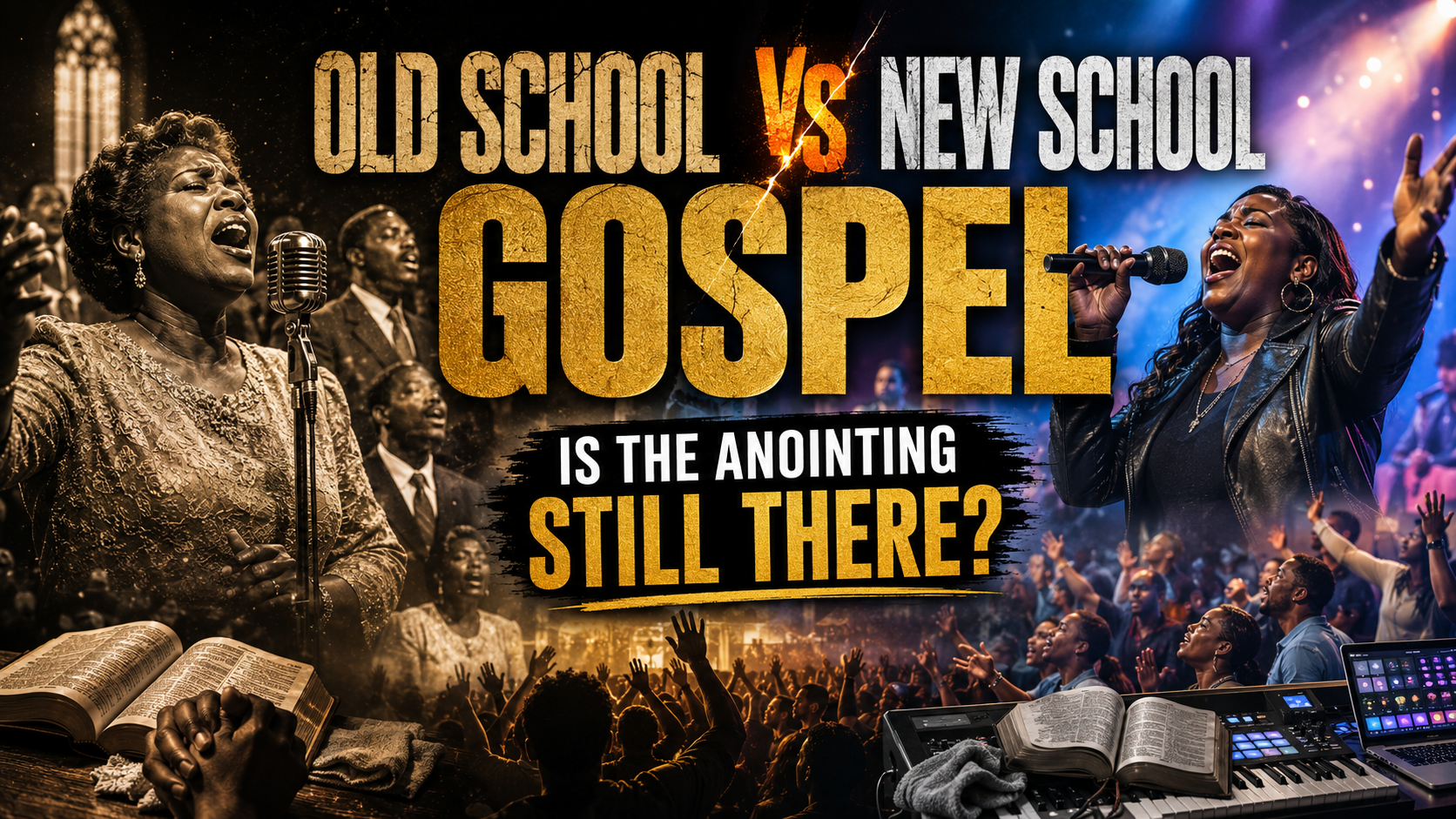
An honest look at what we actually lost, what we gained, and why
the question itself might be the wrong one.
Every few months, somewhere on
Nigerian gospel Twitter or in a church WhatsApp group, the same argument
resurfaces. Someone posts a clip of Panam Percy Paul or Bola Are, captions it
with something like 'they don't make them like this anymore,' and within an
hour the comments have split into two unmoving camps.
Camp one says today's gospel
artists are entertainers wearing ministry as a costume — that the production
has gotten louder while the presence has gotten thinner. Camp two says the
older generation is just nostalgic for their own youth, and that God is not
limited to a particular tempo, decade, or recording quality.
I've sat with this argument for
a long time, partly because I grew up squarely in the middle of the transition
— old enough to remember when Panam Percy Paul's cassette tapes were the
standard, young enough to have Moses Bliss and Limoblaze on my current playlist
without a second thought. So let me try to actually answer the question,
instead of doing what most people do, which is restate one side more
passionately.
What 'Old School' Actually Means
Before comparing eras, it's
worth being precise about what we're actually comparing — because 'old school'
covers a much longer and stranger history than most people realise.
Nigerian gospel music's
recorded history goes back to the 1920s, when J.J. Ransome-Kuti — yes, that
family — became the first Nigerian to record an album, travelling to the United
Kingdom in 1922 to lay down 43 tracks of his compositions. By the 1930s, Ikoli
Harcourt-Whyte was creating the first Igbo-language choral music. Through the
1950s and 60s, Pentecostal churches were exploding across the country, and a
new sound emerged that blended Yoruba musical traditions with Western gospel
structures — a genre now retroactively labelled Contemporary Christian Music,
shaped by figures like Bola Are, Ebenezer Obey, and Panam Percy Paul.
What most people actually mean
by 'old school,' though, is something narrower: the 1990s and 2000s. The era of
Panam, of Tope Alabi, of Sam Okposo and Broda Martyns, who emerged when
Nigerian gospel began modelling itself directly after the new wave of American
gospel stars — Kirk Franklin, The Winans. The era of cassette tapes and CDs
sold after Sunday service, of church choirs in matching uniforms, of songs that
lived primarily inside the four walls of a church building before slowly
leaking into weddings and burials and birthday parties.
If you grew up Nigerian and
Christian anytime in the early 2000s, you know exactly what I mean even without
me naming songs. White gloves. Choreography at the end-of-year party. The
Saturday morning chores soundtrack your mother controlled completely. That's
the 'old school' everyone is actually arguing about.
What Changed, Concretely
The shift from that era to now
didn't happen because anyone made an announcement. It happened the way most
cultural shifts happen — gradually, then suddenly, driven by technology more
than by theology.
The internet did most of the
heavy lifting. Independent artists like Greatman Takit and Limoblaze can now
reach millions through YouTube, Spotify, and TikTok without ever signing to a
label or pressing a single physical CD. That's an entirely different economic
and creative reality from the one Panam Percy Paul or Tope Alabi operated in,
where reach depended on church networks, cassette distribution, and word of
mouth that travelled at the speed of physical movement.
Sound changed too, and not
subtly. Afro-gospel emerged as a genuine subgenre — Christian lyrics and
explicit doctrine delivered over production that borrows directly from
mainstream Afrobeats. Limoblaze is probably the clearest example: the beats
could sit comfortably next to any secular playlist, but the lyrics are
unambiguously about Christ. A more recent and more controversial wrinkle has
artists like Asake and Seyi Vibez sprinkling prayer and scripture into records
that are otherwise built for the club — something writers have started calling
Afro-adura, prayer meeting percussion. Whether that counts as gospel music at
all is its own separate argument, and a genuinely difficult one.
The business model changed most
visibly of all. Gospel concerts now run premium seating tiers and brand
sponsorships. Gospel artists do high-production music videos with the same
visual language as any Afrobeats star. Tim Godfrey collaborating with Oxlade,
or Ehis 'D' Greatest's gospel record getting a remix featuring American rapper
Gunna — these aren't isolated experiments anymore. They're evidence that the
wall between gospel and secular music in Nigeria has gotten a lot thinner than
it used to be.
The Case for 'Yes, Something Was Lost'
I want to take the old-school
argument seriously, because I think it contains a real point buried under a lot
of nostalgia.
There is a textural difference
between a Panam Percy Paul concert recording from the 1990s and a contemporary
gospel music video shot with cinema cameras and colour grading. The older
recordings often have a rawness — congregational, unpolished, sometimes
literally just one microphone and a packed room — that puts the emphasis
entirely on what's happening spiritually rather than what's happening visually.
When 24,000 people showed up to a 3,000-seat hall in Adamawa for a Panam
concert in 1997, there was no algorithm pushing that crowd there. No marketing
push. Just word that something real was happening, travelling person to person.
There's also a legitimate
question about incentives. When your music's success is measured by streaming
numbers, brand partnerships, and ticketed VIP sections, the commercial
machinery becomes genuinely indistinguishable from the secular industry it once
stood apart from. That doesn't automatically mean the substance is gone — but
it does mean the pressures pulling at an artist's choices are different, and
possibly more numerous, than what shaped someone writing songs primarily for
their own congregation in 1995.
And there's a real,
uncomfortable copyright and credit problem that has surfaced repeatedly as the
industry has scaled — disputes over who actually wrote and owns songs that have
become massive hits, the kind of conflict that simply didn't have room to
happen at the same scale when gospel music wasn't generating serious money.
Bigger industry, bigger fights over ownership. That's not a coincidence; it's a
direct consequence of the commercialisation old-school defenders are worried
about.
The Case for 'No, You're Just Nostalgic'
Now the other side, and I think
it's actually the stronger one.
Every generation that grew up
with a particular sound experiences new sounds as somehow less legitimate. This
isn't a gospel-specific phenomenon — it happens with jazz, with rock, with
literally every musical tradition that has ever existed long enough to have a
'classic era' and a 'new era.' The feeling of decline is often just the feeling
of no longer being the target audience.
More importantly: the 'old
school' itself was once the new school, and it received exactly the same
criticism. When Sam Okposo, Tope Alabi, and Broda Martyns started modelling
their music after 1990s American gospel stars, spreading the message beyond the
literal walls of the church, there were certainly older Nigerian Christians at
the time who thought that was a dilution too — too Westernised, too commercial,
too far from the choral hymn tradition they'd grown up with. Every generation's
gospel sound is somebody's 'they've lost the anointing' moment.
And the testimony evidence
doesn't support a decline narrative at all. Nathaniel Bassey's Hallelujah
Challenge — built entirely on smartphone livestreams and social media, the most
'new school' delivery mechanism imaginable — has produced thousands of
documented testimonies of healing, breakthrough, and genuine spiritual
encounter since 2017. Moses Bliss's Afrobeats-inflected praise anthems are
filling churches and arenas with young people who would otherwise have very
little gospel content in their daily listening at all. If anointing is measured
by what it actually produces in people's lives — and I'd argue that's the only
honest measure — the new school is producing plenty of it.
There's also something worth
saying about reach. Sound and Bola Are's generation worked largely within the
church and the immediate diaspora around it. Today's artists, partly because of
the very commercialisation that worries critics, are reaching audiences the old
school structurally could not reach — global streaming platforms, international
collaborations, algorithmic discovery that puts a Nigerian gospel song in front
of a stranger in Texas or Toronto who would never have encountered it any other
way.
Where I've Landed
Here's my honest position,
after going back and forth on this for longer than I probably should have.
I think the question 'is the
anointing still there' is the wrong question, because it assumes anointing is
something that gets used up or diluted by production value, marketing, or
modern instrumentation — as if the Holy Spirit has a preferred bit rate. It
doesn't work that way, and treating it that way flatters older generations
while being genuinely unfair to younger artists who are, by every honest
account, leading real people into real encounters with God.
The better question is whether
an individual artist, in any era, is writing and singing from genuine
conviction or from calculation. That question has nothing to do with whether
the backing track has a trap hi-hat or a live choir behind it. Panam Percy Paul
wrote some songs from deep conviction and probably wrote some others because an
album needed a tenth track. The same is true of every gospel artist working
today, old school or new. The format has never been the determining factor. It
never will be.
What I will say, without
hedging, is that we should resist letting the commercial machinery become the
whole story on either side. The old-school defenders are right that something
genuinely valuable existed in music made primarily for a congregation rather
than for an algorithm — there's a kind of focus that comes from writing for the
twelve people who'll be in the room on Sunday rather than the million who might
stream it on Tuesday. And the new-school defenders are right that gatekeeping
anointing by decade is exactly the kind of cultural snobbery the church should
be most suspicious of in itself.
My honest advice, for what it's
worth: keep both playlists. Let Panam Percy Paul's raw 1990s congregational
recordings remind you what unhurried, unproduced devotion sounds like. Let
Moses Bliss and Limoblaze remind you that God is not allergic to a good beat. The
anointing was never really about the decade. It was always about whether the
person singing actually meant it.
Which
side of this debate do you fall on — and is there an old-school song that still
hits you harder than anything modern? Tell me in the comments, I genuinely want
to know.
Discussion (0)
No comments yet. Be the first to share your thoughts!