Why Gospel Music Is Growing on Streaming Platforms — And What It Actually Means
BY GMUSICVIBES EDITORIAL
Published Jun 18, 2026
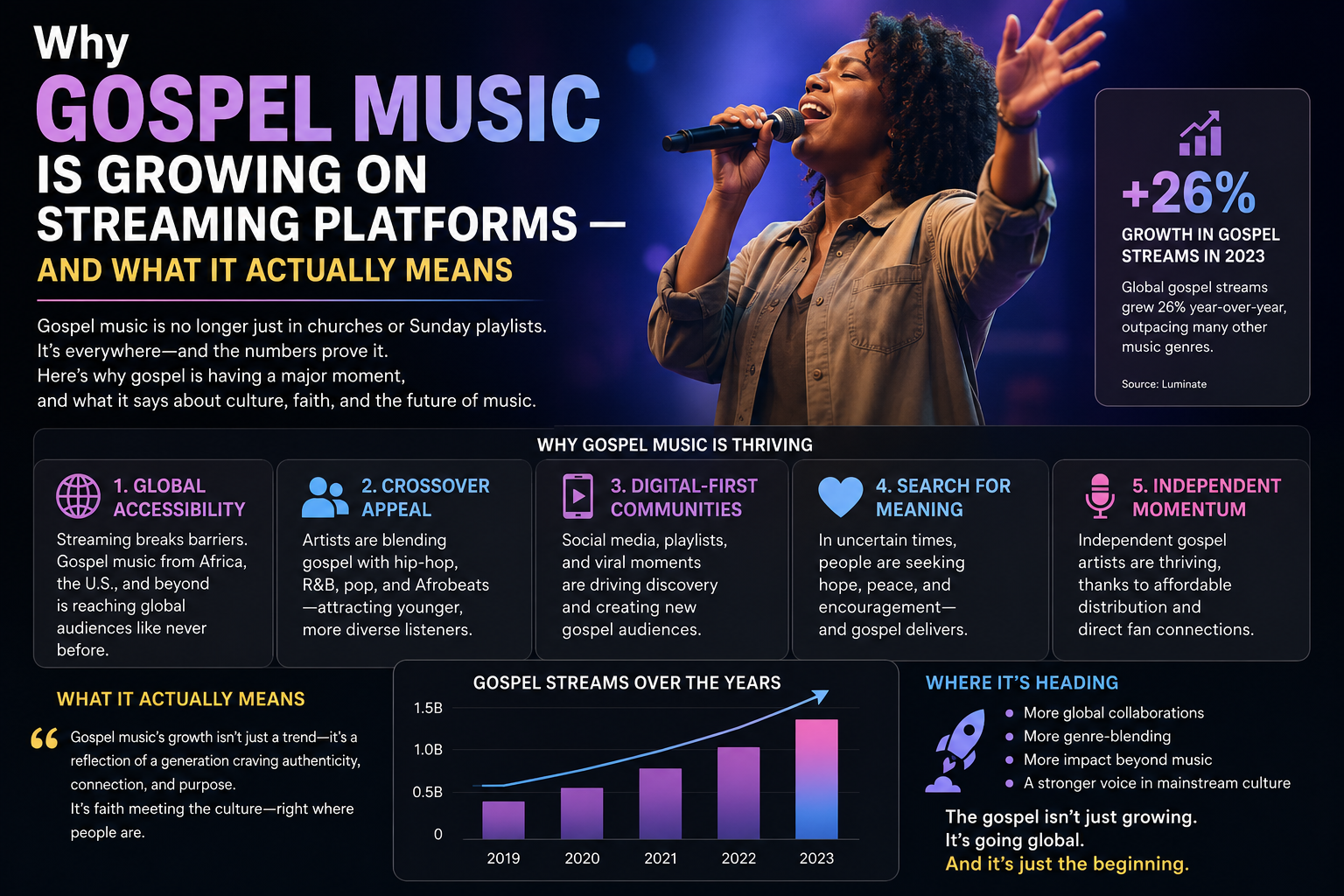
The numbers behind gospel's quiet streaming takeover, and the
deeper story they're telling about who's listening and why.
Something has been happening in
gospel music for the last few years that doesn't get talked about enough
outside of industry reports and year-end data dumps. While most people were
arguing about whether Christian music could ever go mainstream again, it just
quietly did.
Not through a single breakout
hit. Not through one viral moment. Through a sustained, measurable, multi-year
climb that has now turned into one of the clearest growth stories in the entire
global music industry.
I want to walk through what the
actual numbers say, because they're more interesting than most people realise,
and then talk about what's really driving this — because the explanation isn't
simply 'people are more religious now.' It's something more specific, more
generational, and honestly more encouraging than that.
The Numbers, Plainly
Let's start with the headline
figures, because they're genuinely striking.
Christian and gospel music
streams grew 18.5% year-over-year in 2025 compared to 2024. To put that in
context, rock — the biggest growth genre of the year — grew 6.4%. Latin music,
fuelled almost entirely by Bad Bunny's 5.3 billion streams, grew 5.2%. Gospel
and Christian music nearly tripled the growth rate of the next fastest-growing
major genre.
Zoom out further and the picture
gets even more dramatic. Spotify has reported a 60% rise in Contemporary
Christian Music listenership globally over a five-year period, with the
platform's biggest streaming year for the genre on record. According to
Luminate's data, the genre even overtook world music — the category that
includes K-pop and Afrobeats — in overall streaming share this year, something
industry analysts say they had never seen happen before.
In Africa specifically, the
growth has been even sharper. Gospel music streams across sub-Saharan Africa
grew by 50% year-on-year, and by over 3,400% since 2020. In the first quarter
of 2025, Nigerian gospel artists Nathaniel Bassey, Mercy Chinwo, and Moses
Bliss all ranked among the top 20 most-streamed Nigerian acts globally on YouTube
Music — with Moses Bliss actually outperforming Afrobeats artist BNXN during
that period.
These aren't soft,
easily-explained-away numbers. This is a structural shift in how people are
listening.
It's a Younger Audience Now — And That Changes Everything
Here's the detail that explains
almost everything else on this list: gospel and Christian music's audience is
getting significantly younger.
In 2022, 39% of Contemporary
Christian Music listeners were millennials or younger. By 2024, that number had
jumped to 45%. Average monthly listening time for these younger fans also
increased substantially — climbing from 47.9 to 56.8 hours, a 19% jump in how
much time young listeners are actually spending with the music.
This matters because it changes
the entire commercial logic of the genre. For decades, Christian and gospel
music operated on an older-skewing model — Sunday radio, physical CD sales
after church, an audience that aged alongside the artists. A genre with a
45%-and-rising under-40 audience is a completely different commercial animal.
It's a genre with a future, not just a legacy.
TikTok Did What Christian Radio Couldn't
If you want the single biggest
mechanical reason behind this shift, it's social media — and specifically,
TikTok.
Forrest Frank's song 'Your
Way's Better' became a long-running fixture on the Billboard Hot 100 after a
Christian dance trend on TikTok generated more than 38.6 million likes. The
song pushed his U.S. streams above 1.2 billion in a single year. Brandon Lake's
'Hard Fought Hallelujah,' especially after a collaboration with country artist
Jelly Roll, charted on the Hot 100 and built sustained momentum through a fan
base that's overwhelmingly between 18 and 34 years old.
For the first time in eleven
years, two Christian/gospel songs charted simultaneously on the Billboard Hot
100 for multiple weeks. The last time that happened was 2014. Billboard's
senior music data analyst called it a genuinely special moment — two
faith-based artists having a mainstream crossover at the exact same time,
something the genre hadn't pulled off in over a decade.
What's notable is how
deliberate this shift has been. Holly Zabka, president of Provident — the
Christian music arm of Sony — put it simply: the industry stopped waiting for
listeners to find Christian music and started actively going to where listeners
already were. That meant trading the old top-down radio strategy for something
closer to how any other pop genre operates now: frequent single releases,
social-first marketing, and letting audience data — not label instinct — drive
what gets pushed next.
Live Shows Are Following the Streams, Not Leading Them
Touring used to be the thing
that built an audience, which then translated into sales. That order has
essentially flipped.
Forrest Frank's 2024 tour took
him from 2,000-to-5,000-seat clubs into 6,000-to-7,000-seat arenas. His booking
team made that jump specifically because streaming data showed them where the
audience already was — and it was bigger, and younger, than the venue history
would have suggested. Parents at his shows have noticed it directly: rooms that
used to be mostly high schoolers and college students now have families and
considerably younger kids in attendance too.
On the booking side, the agency
that handles much of the Christian music touring market grew from 800 shows and
3.3 million in attendance in 2023 to over 900 shows and more than 4 million
attendees in 2025. Lauren Daigle's 2020 arena tour — cut short by the pandemic
— is frequently cited as the turning point where industry insiders realised
ticket demand for Christian artists had become comparable to mainstream pop
acts, not a niche curiosity anymore.
This Isn't Just an American Story
It would be easy to read all of
this as a uniquely American Christian-radio phenomenon, but the African data
tells a different and in some ways more remarkable version of the same story.
Gospel music claimed the ninth
spot among the most-streamed genres across sub-Saharan Africa in Spotify
Wrapped 2024. By 2025, gospel artists from the region weren't just sustaining
that position — they were outperforming several Afrobeats acts on the same
platforms, a genre that has dominated African streaming conversations for
years. What had been treated as a seasonal, church-bound category of music became
something people were streaming as part of ordinary, everyday listening.
This is the part of the story
that should matter most to anyone making gospel content right now, whether
you're an artist, a blogger, or running a YouTube channel. The infrastructure
that used to gatekeep gospel music — radio formats, physical distribution,
label relationships, regional reach — has been almost entirely bypassed. An
artist or a piece of content doesn't need a record deal or a broadcast slot to
reach a global audience anymore. It needs to be good, and it needs to find the
right algorithmic moment.
The Honest Complications
None of this growth has been
entirely clean, and it's worth saying so.
As gospel and Christian music
has become more commercially significant, the tension between ministry and
business has become more visible too. Maverick City Music — one of the acts
bridging the worlds of contemporary worship and gospel most successfully — has
dealt with serious internal conflict, including a member departing in 2025 and
filing a lawsuit alleging that millions of dollars in royalties had been
withheld from him. That's not a footnote. It's a reminder that bigger audiences
and bigger money bring bigger problems, and the genre is still working out how
to hold spiritual purpose and commercial scale at the same time.
There's also a fair question
about why some of this growth is happening right now, in this particular
cultural and political moment. Some analysts have pointed to a broader return
of conservative cultural energy in the United States as part of the
explanation, alongside the more straightforward post-pandemic pattern of people
turning to music — and to faith — during a period of collective uncertainty.
The truthful answer is probably 'several things at once,' and anyone offering a
single tidy explanation is probably oversimplifying.
What This Means If You're Building Something in This Space
If you create gospel content —
music, videos, blog writing, anything — the practical takeaway from all of this
data is fairly clear.
The audience exists, it's
younger than it's ever been, and it's actively looking for content in the
places it already spends time: TikTok, Instagram, YouTube, Spotify playlists
curated for personal devotion rather than Sunday service. The old assumption
that gospel content has a ceiling — that it can only ever reach a modest,
ageing, denominationally specific audience — simply isn't supported by what the
data is showing anymore.
What does seem to matter,
across every example in this growth story, is authenticity over polish. Forrest
Frank's audience responded to a dance trend, not a marketing campaign. Tasha
Cobbs Leonard's collaboration on a 2026 Forrest Frank track works because both
artists bring genuine spiritual conviction to a song, not because a label
calculated a crossover strategy. The listeners driving this growth —
disproportionately under 35 — have an unusually good radar for content that
feels manufactured. They reward the real thing, often quite visibly and
quickly.
Gospel music spent a long time
being treated, even by some of the people who loved it most, as a smaller and
slightly less serious category than the rest of the music industry. The numbers
from the last two years suggest that era may genuinely be ending. Not because
gospel changed what it's about. Because the rest of the world's listening
habits changed in a way that finally lined up with what gospel had been doing
the whole time — being honest, in public, about things that actually matter.
Have you
noticed gospel and worship music showing up more in your own feed — on TikTok,
Spotify, or YouTube? I'd love to hear what's been landing for you lately. Drop
it in the comments.
Discussion (0)
No comments yet. Be the first to share your thoughts!