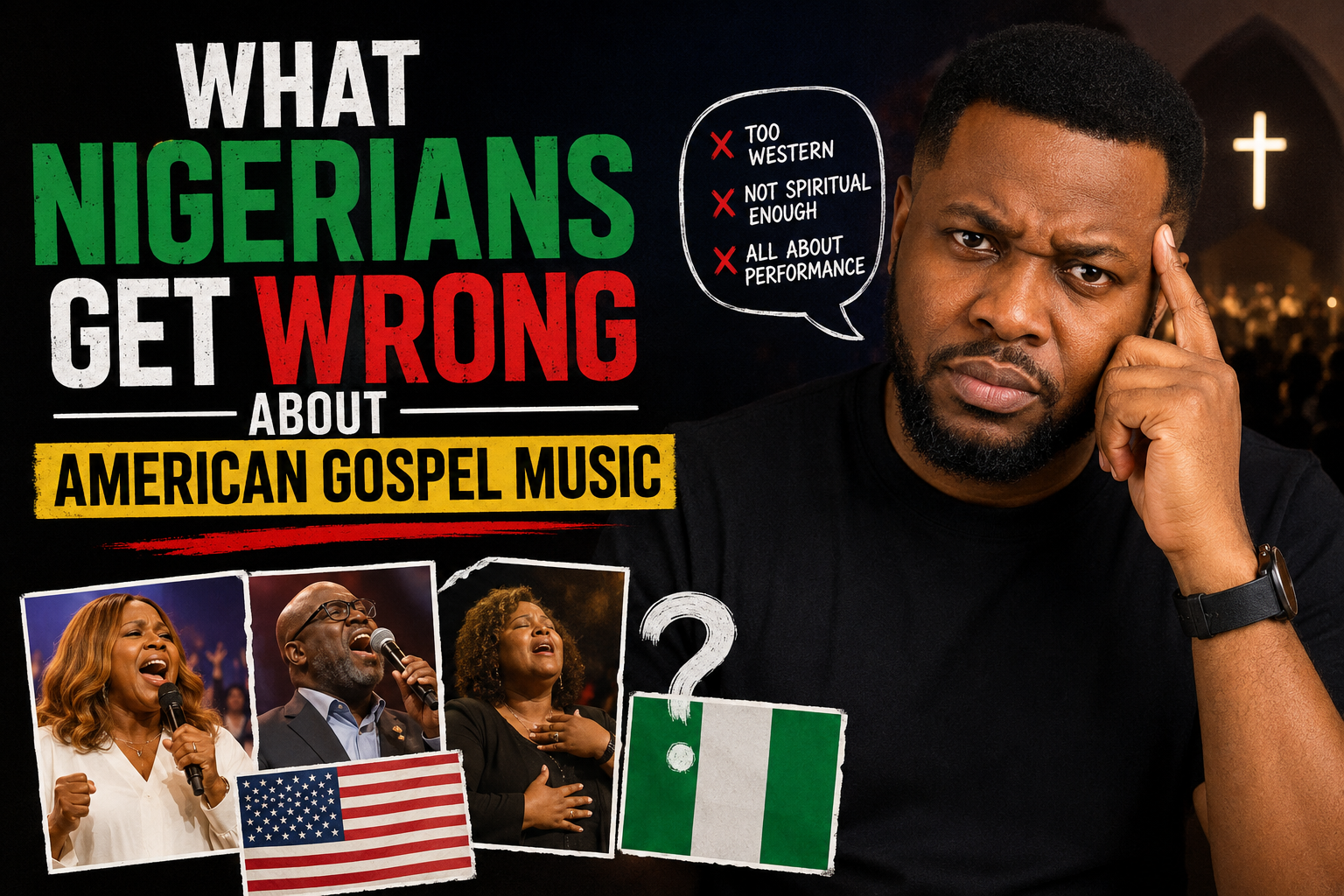
What Nigerians Get Wrong About American Gospel Music
BY GMUSICVIBES EDITORIAL
Published Jun 16, 2026
An honest conversation about the myths we grew up with — and
what the truth actually changes.
Let me start with something
that might be uncomfortable.
A lot of us grew up treating
American gospel music the way we treated foreign currency — as though it was
simply worth more. Kirk Franklin was the standard. CeCe Winans was the ceiling.
Donnie McClurkin singing at our church was the highest validation a Nigerian
congregation could receive. American gospel wasn't just music we listened to.
For many of us, it was the definition of what gospel was supposed to sound
like.
I'm not here to tear that down.
Some of that music genuinely changed lives, including mine. But I've been
thinking lately about some of the ideas we absorbed along the way — ideas that
were never quite true, and that may have quietly done us some harm. So this is
that conversation. Honest, a little uncomfortable, and hopefully useful.
Myth #1: American Gospel Is More Anointed
This one is the most sensitive,
so let's deal with it first.
There was — and in some corners
still is — a subtle belief that American gospel music carries a heavier
anointing. That when Kirk Franklin leads a song, something different happens
spiritually than when Nathaniel Bassey does. That Tasha Cobbs Leonard's voice
touches God in a way that Tope Alabi's cannot.
This belief was never
theological. It was cultural. It came from decades of consuming American music,
American television, American church broadcasts — and slowly internalising the
idea that proximity to America meant proximity to holiness. It was the same
logic that made us value foreign goods over local ones in every other area of
life.
The truth is that anointing
doesn't carry a passport. The Spirit of God doesn't prefer one accent over
another. Panam Percy Paul leading ten thousand people in worship in Adamawa is
operating in the same anointing as any American artist filling a stadium in
Atlanta. If you've ever been in a room where Nathaniel Bassey played trumpet
and the presence of God became something you could feel on your skin, you
already know this. But sometimes we need to say it plainly.
Myth #2: American Gospel Artists Are All Ministry-First
Here is something the Nigerian
church doesn't always talk about: American gospel music is a commercial
industry. A very large one.
Gospel music in the United
States has been a major part of the recording industry for decades, with
artists touring worldwide, signing major label deals, and pursuing mainstream
crossover success. The Grammy Awards have an entire gospel category. There are
gospel-specific Billboard charts, gospel-specific radio formats, gospel
publicists, gospel managers, gospel booking agents. It is a business.
That's not an accusation.
Ministry and commerce can coexist, and many American gospel artists navigate
that tension with genuine integrity. But the Nigerian assumption that American
gospel artists are universally operating from a place of pure spiritual calling
— untouched by commercial pressures, industry politics, or the pursuit of
celebrity — is simply not accurate.
Some of the most spiritually
grounded music I've ever encountered came from Nigerian artists who recorded
albums in home studios with modest budgets and released them with almost no
marketing. The absence of production polish is not the absence of anointing. We
sometimes confused the two.
Myth #3: The Music That Gets Exported Is the Best Music
This is perhaps the most
practically damaging myth of the group.
The American gospel music that
made it to Nigerian churches — through CDs, radio, satellite television — was
not a representative sample. It was a curated selection, filtered through
distribution deals, radio formats, and the preferences of whoever controlled
the import channels. The music that arrived was the music that had commercial
infrastructure behind it.
What this means is that for
years, Nigerians formed opinions about the depth and breadth of American gospel
based on a very narrow slice. The music of small congregations in Mississippi,
of storefront churches in Detroit, of regional gospel traditions that never got
label deals — none of that made the journey. We heard the polished surface and
assumed it was the whole ocean.
Meanwhile, Nigerian gospel has always had a far wider range than what got exported in return. For every Sinach who eventually reached global audiences, there were dozens of artists singing in local languages, in regional styles, with theological depth and musical sophistication that went completely unnoticed outside their denominations. We undervalued our own depth because we were too busy measuring ourselves against someone else's highlight reel.
Myth #4: Their Worship Style Is More Reverent
Nigerian Christians who visit
American churches for the first time are sometimes surprised.
The expectation, shaped by
television broadcasts and conference recordings, is a certain kind of polished
reverence. What many actually find is something more varied — churches that are
quieter and more liturgical than expected, congregations that sit during
worship in ways that would be unthinkable in a Nigerian Pentecostal setting,
worship services that end after 45 minutes and feel almost businesslike by
Nigerian standards.
This isn't a criticism of
American worship culture. It's just that what we exported as 'American gospel
worship' was primarily the Pentecostal and charismatic stream — the most
energetic, most emotionally expressive, most Nigerian-adjacent version of
American Christian music. We absorbed it and assumed it was the whole picture.
The truth is that American
Christianity is denominationally diverse in ways that Nigerian Christianity,
which is heavily Pentecostal-dominated in its public image, often isn't. The
worship of a Black Baptist church in Memphis sounds nothing like a
Hillsong-influenced megachurch in Houston. Neither sounds like the Episcopal
service in Connecticut. We absorbed one stream and thought we understood the
river.
Myth #5: Our Music Was Playing Catch-Up
This might be the one that
stings most, because many of us believed it for a long time.
The narrative went something
like this: American gospel invented the form. Nigerian gospel adapted it. We
were downstream, derivative, always arriving after the real thing had already
happened somewhere else.
The historical record tells a
different story. The roots of what we call gospel music are deeply African —
call and response, polyrhythmic structures, communal participation, the
blurring of the line between song and prayer. These were African inheritances
that survived the Middle Passage and eventually became the foundation of
American gospel. What America formalised and commercialised began, in
significant part, in African musical soil.
More practically: Nigerian
gospel has been innovating continuously since the 1980s. Panam Percy Paul was
blending highlife and country gospel in ways that had no American equivalent.
Tope Alabi built an entirely indigenous Yoruba gospel tradition that ministered
to audiences American gospel could never reach. Contemporary artists like
Dunsin Oyekan and Maverick Zaike are producing sounds that American worship
musicians are now actively trying to incorporate.
The pipeline doesn't only run
one direction. It never did. We just weren't always paying attention to the
flow going the other way.
What We Got Right
Fairness requires this section.
American gospel music gave
Nigerian Christians a lot that was genuinely valuable. The production quality
raised the standard for what church music could sound like. The theological
rigour of artists like Kirk Franklin — who wrote songs that engaged seriously
with doubt, struggle, and the complexity of faith — modelled a kind of honest
worship that was sometimes missing from the relentlessly triumphant tone of
Nigerian Pentecostal music. The cross-genre experiments of artists like Fred
Hammond showed that gospel didn't have to be sonically conservative to be
spiritually serious.
And the personal testimonies
carried in American gospel music — shaped by the specific history of African
Americans, by struggle and resilience and the long arc toward justice — spoke
to Nigerian listeners who recognised something ancestral in them, even across
the distance of ocean and culture.
None of that is nothing. All of
it mattered.
The Honest Takeaway
What I'm suggesting isn't that
we stop listening to American gospel, or that we replace one set of uncritical
loyalties with another. I'm not waving a flag for Nigerian gospel supremacy any
more than I'm defending the unexamined elevation of American music.
I'm suggesting that we listen
with more informed ears. That we understand what American gospel music is — a
rich, complex, commercially embedded tradition with extraordinary highs and
real limitations — rather than treating it as a monolith of spiritual superiority.
That we hold our own tradition with more confidence, knowing that it is not
derivative but generative, not catching up but contributing.
Sinach didn't just break into
the American market. She rewrote what was possible for any African artist in a
space that had largely ignored the continent's contributions. The fact that
American churches eventually sang her song doesn't validate it. The song was
already valid. The American churches just finally noticed.
That distinction matters. The
music that ministers to you is holy. Wherever it came from.
What was
the American gospel song you grew up with that meant the most to you? And do
you hear Nigerian gospel differently now than you did ten years ago? I'd love
to know in the comments.
Discussion (0)
No comments yet. Be the first to share your thoughts!